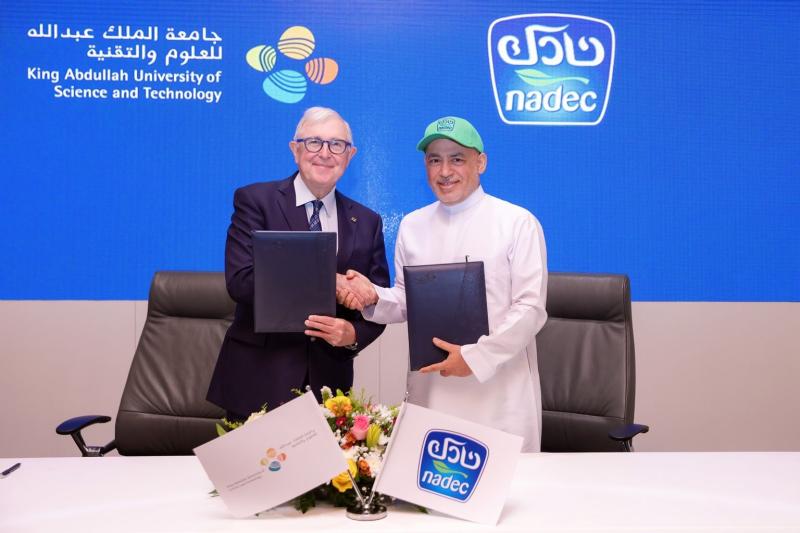
Strengthening Saudi Arabia’s food systems requires close collaboration between scientific research and large-scale agricultural practice. King Abdullah University of Science and Technology (KAUST) and the National Agricultural Development Company (NADEC) are bringing these strengths together through a new collaboration focused on applied research, innovation, and talent development.
KAUST and NADEC have signed a memorandum of understanding (MoU) that establishes a framework for long-term cooperation across agricultural research, technology development, and professional training. The agreement reflects a shared ambition to translate scientific insight into practical solutions that make the Kingdom’s food and agriculture sector resilient and stable for the future.
Signed by KAUST President Sir Edward Byrne AC, and NADEC Chief Executive Officer, Dr. Solaiman bin Abdulaziz Al-Twaijri, the MoU enables closer collaboration between KAUST’s research ecosystem and NADEC’s operational footprint. Embedding research into the agriculture sector accelerates innovation because solutions that can be tested, refined, and scaled at pace.
Speaking on the collaboration, KAUST President Sir Edward Byrne AC said: “Food security is one of the most critical challenges facing the global scientific community today — in Saudi Arabia and far beyond. Partnerships between science and industry are essential, particularly in complex food systems. While the urgency is real, this is also an exciting moment — an opportunity to think differently and develop smarter ways to deliver healthy, sustainable food in the face of mounting environmental pressures, especially water scarcity and rising temperatures. We are extremely excited, and hopeful, about this collaboration with NADEC, Saudi Arabia’s leading agricultural company, and we believe it represents a clear pathway to real-world impact."
The work will be led by KAUST’s Center of Excellence for Sustainable Food Security, which was established to drive delivery of research across multiple technologies to food systems in Saudi Arabia. Through the agreement, KAUST researchers will gain access to NADEC field sites, operational data, and production environments, allowing research and technology validation to take place in real agricultural contexts.
Speaking on the agreement, Dr. Solaiman bin Abdulaziz Al-Twaijri, Chief Executive Officer at NADEC, said, "The memorandum represents a strategic step toward the integration of scientific research with real-world agricultural application."
He noted that the partnership is expected to contribute to the development of innovative, sustainable solutions that enhance productivity while addressing challenges in natural resource management, particularly water efficiency and soil health, adding that "Cooperation with KAUST, given its advanced research ecosystem and scientific contributions in agriculture, food systems, and biotechnology, opens opportunities to apply cutting-edge research in operational settings while supporting national capacity-building and talent development."
“Work like this is incredibly important because food systems can only be improved when scientific discoveries are tested under real conditions. Water limitations, soil health, climate, and scale all matter — and they cannot be fully understood in isolation.” Comments Mark Tester, Chair of The Center of Excellence for Sustainable Food Security: “Through the Center of Excellence our role is to ensure research is developed with deployment in mind. Collaborating with NADEC allows us to learn directly from production environments, generate robust evidence, and build solutions that are practical, resilient, and suited to Saudi Arabia’s long-term needs.”
National talent and workforce development will also be a key focus, and the collaboration will support student training, startup engagement, and sponsored research. Through KAUST’s academic and innovation platforms, including its training and professional development programs, the partnership aims to support skills development alongside technological progress.
From KAUST’s perspective, the partnership reflects the University’s role as a national platform for applied science — connecting discovery, innovation, and deployment.