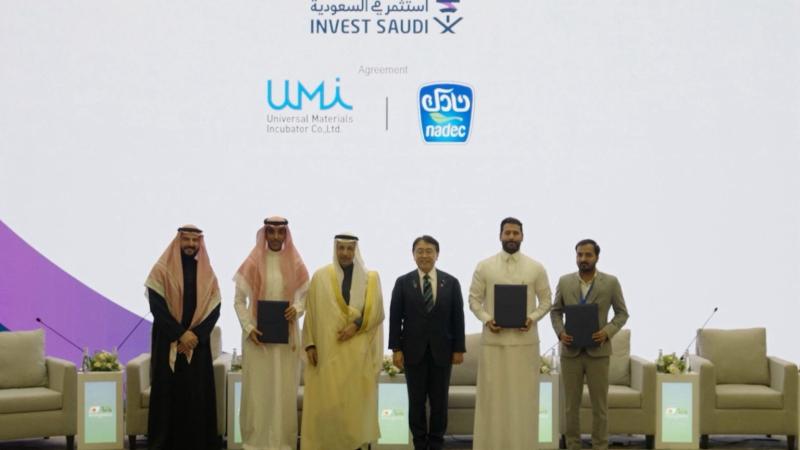
As part of its commitment to developing the agricultural sector and adopting innovative solutions, the National Agricultural Development Company (NADEC) signed two memoranda of understanding with Universal Materials Incubator (UMI) and EF Polymer (InnerBloom). The agreements aim to conduct field trials and technical and strategic evaluations that contribute to improving resource-use efficiency and strengthening the Kingdom’s food security ecosystem.
The memoranda were signed under the patronage and in the presence of His Excellency the Minister of Investment, Mr. Khalid bin Abdulaziz Al-Falih, and His Excellency the Japanese Minister of Economy, Trade and Industry, Mr. Ryosei Akazawa, on the sidelines of the Saudi–Japanese Ministerial Meeting. This reflects the depth of international partnerships supporting the development of the agricultural sector and the advancement of innovation in the Kingdom.
These agreements align with NADEC’s strategic direction to invest in advanced agricultural technologies, enhance water-use efficiency, and support sustainable agricultural practices, in line with national food security objectives and Saudi Vision 2030.
The memorandum signed with EF Polymer includes the implementation of field-based agricultural trials to test an advanced soil-treatment technology based on biodegradable organic materials. The technology aims to improve soil water retention, reduce irrigation water consumption, and increase agricultural productivity. Data and results generated from these trials will be used to assess opportunities for long-term strategic collaboration.
Meanwhile, the memorandum signed with UMI focuses on the technical and strategic evaluation of advanced agricultural solutions, including conducting technical due diligence and exchanging data and expertise, with the objective of enhancing agricultural performance and adopting innovative solutions with sustainable impact.
NADEC emphasized that strategic agriculture today requires a long-term commitment to soil health and efficient resource circulation, noting that the company is leading the transition toward regenerative agricultural practices that restore natural capital rather than deplete it. NADEC further highlighted that diversifying investment crops, adopting closed-loop nutrient management systems, and deploying smart irrigation technologies powered by artificial intelligence—along with satellite-based agricultural monitoring systems—contribute to maximizing water and land-use efficiency, mitigating climate risks in real time, and reducing carbon footprint.
The company also noted that these trials focus on scalable strategic crops, such as wheat and olive trees, supporting the future of food security in the Kingdom on sustainable and locally driven foundations.
These memoranda form part of NADEC’s ongoing efforts to embrace innovation, enhance sustainability, and support the transformation toward a more efficient and resilient agricultural sector.